


Aquaponics Market to Witness Robust 8.2% CAGR, Surpassing USD 2,155.3 Million by 2036
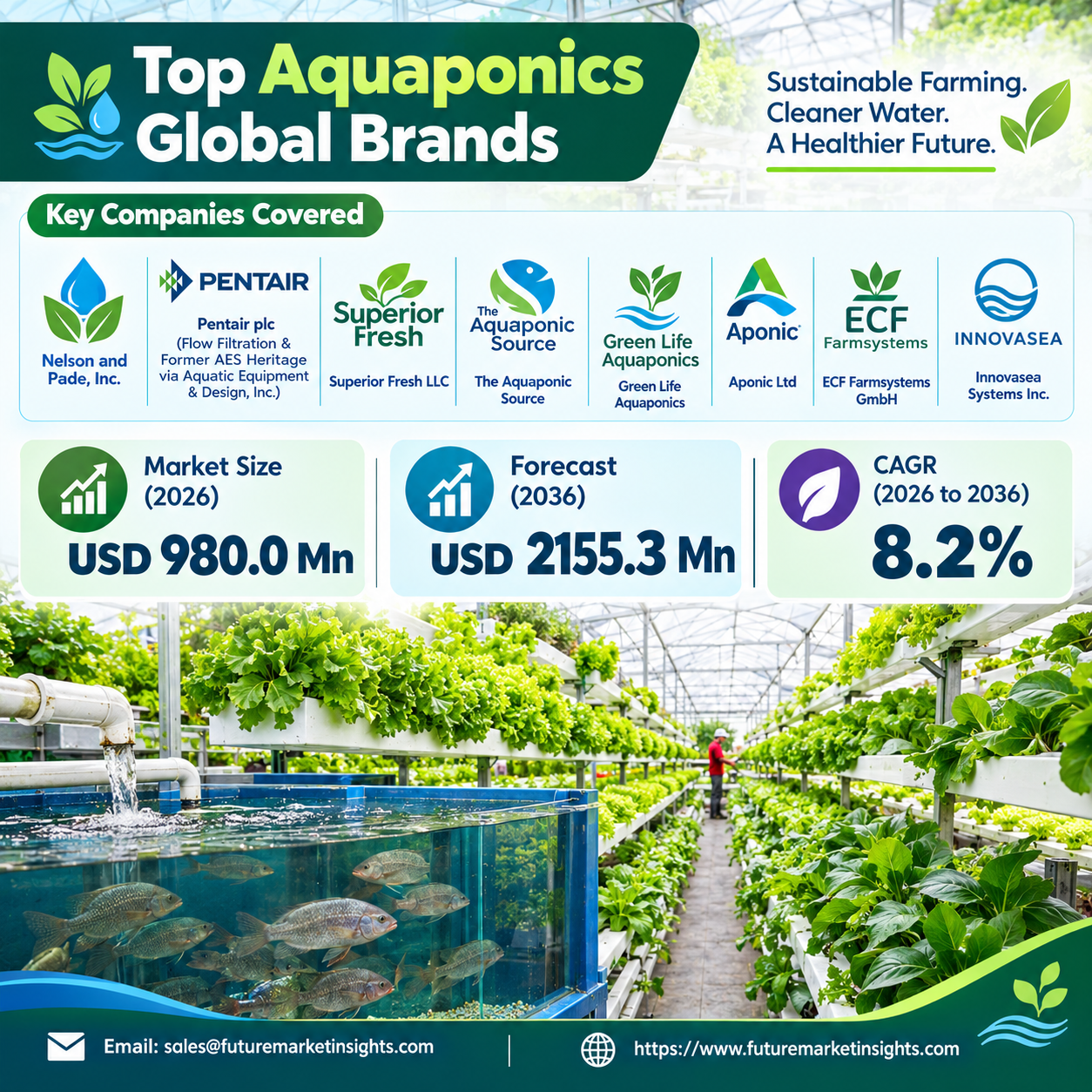
Aquaponics Market to Reach USD 2,155.3 Million by 2036
NEWARK, Del., October 23, 2026 — The global aquaponics market is gaining momentum as agricultural producers, commercial greenhouse operators, and controlled-environment farming businesses explore integrated systems that combine aquaculture with hydroponic crop production. According to the latest market intelligence report published by Future Market Insights (FMI), the global aquaponics market is valued at USD 980.0 million in 2026, up from USD 910.0 million in 2025. The market is projected to reach USD 2,155.3 million by 2036, expanding at a compound annual growth rate (CAGR) of 8.2% over the forecast period. Growth is supported by increasing interest in resource-efficient agriculture, sustainable food production, recirculating systems, and commercial greenhouse installations.
Aquaponics Market Key Market Takeaways
- Market Valuation: USD 980.0 million in 2026, rising to USD 2,155.3 million by 2036.
- Historical Market Value: USD 910.0 million in 2025.
- Growth Rate: Expanding at a CAGR of 8.2% from 2026 to 2036.
- Core Growth Driver: Growing interest in sustainable food production, water-efficient farming, and integrated aquaculture and hydroponic systems.
- Key Application Opportunities: Commercial greenhouses, recirculating aquaponics installations, and controlled-environment agriculture.
- Industry Focus: Improving resource utilization, supporting fresh produce cultivation, and integrating fish and plant production within interconnected systems.
Get Detailed Market Forecasts, Competitive Benchmarking & Industry Insights: Request a Sample Report: https://www.futuremarketinsights.com/reports/sample/rep-gb-4376
Industry Shifts & Market Dynamics
The aquaponics market is evolving as agricultural businesses seek production systems that can improve resource utilization while supporting the cultivation of fish and plants within a connected environment. Aquaponics combines aquaculture, or fish farming, with hydroponics, in which plants grow without soil. In an integrated system, nutrient-rich water from fish production supports plant growth, while biological filtration and plant nutrient uptake contribute to water management and recirculation.
Commercial greenhouse operators and controlled-environment agriculture businesses are exploring aquaponics as part of broader efforts to diversify food production systems. The integration of fish and crop cultivation can provide multiple potential revenue streams, although commercial performance depends on system design, operating costs, production management, and local market demand.
Recirculating installations are an important area of interest because they enable water to circulate through interconnected production and filtration components. Effective water-quality management, oxygenation, nutrient balancing, and biological filtration are essential to maintaining suitable growing conditions for both fish and plants.
Technology development is also influencing market opportunities. Automated monitoring, environmental controls, water circulation equipment, and system-management technologies can help operators monitor operating conditions and improve consistency. However, the benefits depend on installation scale, equipment reliability, energy consumption, and the technical expertise available to manage the system.
Commercial adoption continues to require careful consideration of initial investment, operating expenses, production planning, and the economics of selling both fish and crops. Businesses must also account for the different environmental requirements of aquatic species and plants, which can complicate system design and daily management.
Companies that combine efficient system engineering with reliable production practices, appropriate crop and fish selection, and access to established distribution channels may be better positioned to capture opportunities in the expanding aquaponics market.
Key Opportunities Influencing the Aquaponics Market
Aquaponics offers opportunities across several areas of agricultural production and technology development.
- Commercial Greenhouse Integration: Greenhouse installations can provide controlled growing conditions and support integrated fish and plant production throughout the year, depending on local climate and operating capabilities.
- Water Recirculation and Resource Efficiency: Recirculating systems can reduce the need for continuous water replacement compared with certain conventional production methods, although actual savings depend on system design and operating practices.
- Controlled-Environment Agriculture: Aquaponics can complement indoor farming and greenhouse production strategies where businesses prioritize monitoring, environmental control, and predictable growing conditions.
- Integrated Food Production: Combining aquaculture and plant cultivation creates opportunities to diversify farm output and explore complementary revenue streams.
- Automation and Monitoring: Sensors, water-quality monitoring, and automated controls can support more consistent system management and help operators identify production issues.
- Local and Fresh Food Supply: Urban and peri-urban installations may offer opportunities to supply fresh produce and selected fish products to nearby retailers, restaurants, and consumers.
Despite these opportunities, commercial operators must address capital requirements, energy costs, technical complexity, water-quality management, disease prevention, and the need to maintain reliable yields. The commercial viability of each installation depends on local production conditions, market access, and the ability to manage operating expenses.
Key Players Influencing the Aquaponics Market
The aquaponics market includes specialized system developers, aquaculture technology providers, controlled-environment agriculture businesses, and suppliers of equipment used in integrated fish and plant production.
Competitive positioning in this industry is influenced by system design, filtration technology, water-management capabilities, automation, installation support, and operational expertise. Businesses serving commercial greenhouse and recirculating installations may also differentiate themselves through system customization, technical services, and solutions designed for specific production environments.
As the market develops, equipment reliability, efficient resource management, production consistency, and the ability to integrate aquaculture with crop cultivation are expected to remain important competitive considerations.
Note: A verified company list was not included in the supplied market data. Specific company names and market-share claims should be confirmed against the official FMI report before publication.
Recent Developments and Industry Trends in the Aquaponics Market
- Integrated Production Systems: Interest in combining aquaculture and hydroponics is creating opportunities for agricultural businesses seeking diversified production models.
- Recirculating Installation Development: Water circulation, filtration, and treatment technologies remain important components of aquaponics system design.
- Commercial Greenhouse Applications: Greenhouse-based installations offer opportunities to combine environmental control with integrated fish and plant production.
- Automation and Digital Monitoring: Sensors and monitoring systems can support water-quality management and operational oversight.
- Resource-Efficient Agriculture: Growing attention to water management and sustainable food production is encouraging interest in alternative farming approaches.
- Operational Optimization: Producers are evaluating system layouts, species selection, energy requirements, and production schedules to improve commercial feasibility.
These points represent broader industry trends and areas of potential investment rather than independently verified announcements by individual companies.
Aquaponics Market Report: https://www.futuremarketinsights.com/reports/aquaponics-market
Regional Market Summary
The outlook for aquaponics varies across regions according to agricultural infrastructure, water availability, investment conditions, access to technical expertise, and demand for locally produced food. Commercial greenhouse development and interest in controlled-environment agriculture can create opportunities for integrated aquaponics systems, particularly where producers have access to suitable facilities and established markets.
Regions with developed greenhouse industries and advanced aquaculture capabilities may offer opportunities to deploy technically sophisticated systems. Meanwhile, emerging agricultural markets may explore aquaponics as part of efforts to diversify production and develop new approaches to food cultivation.
However, adoption is not determined by sustainability considerations alone. Electricity prices, equipment costs, climate conditions, availability of trained operators, and the market value of fish and crops all influence investment decisions.
The supplied FMI market figures establish the global forecast but do not include country-level growth rates or regional market shares. Specific regional rankings and country CAGRs should therefore be verified against the official report before being presented as quantified findings.
Analyst Insights
The aquaponics market is positioned at the intersection of aquaculture, hydroponics, greenhouse production, and controlled-environment agriculture. Its projected expansion from USD 980.0 million in 2026 to USD 2,155.3 million by 2036, at a CAGR of 8.2%, indicates increasing commercial interest in integrated food-production systems.
The market opportunity extends beyond installing equipment. Successful implementation requires coordination across fish production, plant nutrition, biological filtration, water circulation, and environmental management. Operators must maintain conditions that support both aquatic species and crop development while controlling energy consumption and labor requirements.
Commercial greenhouses and recirculating installations provide important areas for potential adoption. These systems can help producers manage growing conditions and integrate multiple production activities, but investment decisions require a clear understanding of installation costs, expected yields, and market demand.
Technology providers may find opportunities in monitoring equipment, filtration systems, automation, and system integration. Agricultural operators, meanwhile, must assess whether aquaponics can deliver a commercially viable combination of fish and crop output under local operating conditions.
As the industry develops, businesses that combine appropriate system design, reliable operational management, resource efficiency, and access to profitable markets may be better positioned to benefit from the projected growth of the global aquaponics market.
Frequently Asked Questions
Q: What is the projected size of the aquaponics market by 2036?
A: The global aquaponics market is projected to reach USD 2,155.3 million by 2036, increasing from USD 980.0 million in 2026.
Q: What was the aquaponics market size in 2025?
A: The worldwide aquaponics market was valued at USD 910.0 million in 2025.
Q: What is the expected growth rate of the aquaponics market?
A: The market is forecast to grow at a CAGR of 8.2% from 2026 to 2036.
Q: What is aquaponics?
A: Aquaponics is an integrated food-production approach that combines aquaculture, or fish farming, with hydroponics, or soil-free plant cultivation. Nutrient-rich water from fish production is circulated through a system that supports plant growth and water management.
Q: What factors are driving the aquaponics market?
A: Key areas supporting market interest include sustainable food production, water recirculation, commercial greenhouse development, controlled-environment agriculture, and the potential to combine fish and plant production.
Q: What are the major applications of aquaponics?
A: Applications include commercial greenhouses, integrated fish and vegetable production, controlled-environment farming, and recirculating aquaculture systems incorporating plant cultivation.
Q: How does recirculation support aquaponics systems?
A: Recirculation allows water to move through interconnected production and filtration components. Effective filtration and water-quality management are essential for maintaining conditions suitable for fish and plants.
Q: What challenges affect the aquaponics market?
A: Important challenges include high initial investment, energy consumption, system complexity, water-quality management, technical skill requirements, and the need to maintain commercially viable fish and crop yields.
Q: How can technology influence aquaponics development?
A: Monitoring sensors, automated controls, filtration equipment, and environmental management technologies can help operators oversee water quality, maintain suitable growing conditions, and improve operational consistency.
Q: What is the outlook for the aquaponics market?
A: The market is projected to expand steadily through 2036, supported by interest in integrated production systems and controlled-environment agriculture. Actual adoption will depend on operating economics, technology performance, and local market demand.
Related Food & Agriculture Industry Reports
Sleep Supplement Market https://www.futuremarketinsights.com/reports/sleep-supplement-market
Commercial Seaweed Market https://www.futuremarketinsights.com/reports/commercial-seaweed-market
Cane Sugar Market https://www.futuremarketinsights.com/reports/cane-sugar-market
Beetroot Powder Market https://www.futuremarketinsights.com/reports/beetroot-powder-market
About Future Market Insights
Future Market Insights (FMI) is an ESOMAR-certified market research and consulting firm providing syndicated, customized, investment, and social media research across industries, including food and beverage, healthcare, chemicals, technology, and consumer products. FMI delivers market intelligence, competitive analysis, and strategic insights to help organizations evaluate emerging opportunities and make informed business decisions. The company has offices in the United States, the United Kingdom, the UAE, and India.
Media Contact
For Press & Corporate Inquiries
Rahul Singh
AVP – Marketing and Growth Strategy
Future Market Insights, Inc.
Phone: +91 8600020075
For Sales: sales@futuremarketinsights.com
For Media: Rahul.singh@futuremarketinsights.com
Website: https://www.futuremarketinsights

 English
 Arabic
 French
 Spanish
 Deutsch
 Turkish
 Dutch
 Italiano
 Russian
 Romaian
 Portuguese (Brazil)
 Greek