


What future innovations may influence IVF Labs Design?
INTRODUCTION
The future of fertility treatment will increasingly depend on laboratories that combine advanced technology, precise environmental control, and efficient embryology workflows. IVF Labs Design is evolving to accommodate artificial intelligence (AI), automated laboratory equipment, advanced embryo monitoring, digital traceability, and smarter environmental management. These innovations may help laboratories standardise processes, improve operational consistency, and manage increasingly complex procedures. However, technology must be integrated carefully, with appropriate validation, regulatory compliance, and professional oversight. Planning for future innovations during the design stage can help fertility clinics create adaptable facilities that support current clinical needs while remaining prepared for emerging reproductive technologies.
1. Artificial Intelligence in Embryology Laboratories
Artificial intelligence is becoming an important area of development in assisted reproductive technology. AI systems can analyse embryo images, identify patterns in developmental data, and assist embryologists with assessment and decision-making.
Future IVF laboratories may incorporate AI tools that support:
- Automated embryo image analysis
- Consistent embryo grading workflows
- Time-lapse developmental data interpretation
- Laboratory performance analysis
- Digital quality management
- Decision-support systems for embryologists
These technologies may influence workstation layouts, computer infrastructure, data storage, and software integration requirements.
However, AI should be treated as a decision-support technology rather than a guaranteed method of improving pregnancy or live-birth rates. Clinical evidence varies between applications, and human review remains essential. Laboratory designers should provide appropriate digital infrastructure without assuming that every AI tool will become a standard clinical requirement.
2. Advanced Time-Lapse Embryo Monitoring
Time-lapse incubators allow embryos to be observed through integrated imaging systems without repeatedly removing them for conventional assessment.
This technology can provide detailed information about developmental timing and morphology. Future systems may combine time-lapse imaging with improved analytical software and automated data interpretation.
From a design perspective, these systems may require:
- Dedicated incubator locations
- Stable temperature and environmental conditions
- Reliable electrical supply and backup power
- Secure data connections
- Appropriate work surfaces
- Convenient access for embryologists
- Integration with laboratory information systems
The layout should also minimise unnecessary movement and help maintain efficient workflows.
Time-lapse monitoring can provide useful developmental information, but its availability alone does not establish better clinical outcomes. Technology selection should be based on the clinic's objectives, available evidence, and operational requirements.
3. Automation and Robotics in IVF Laboratories
Automation is another major development influencing future laboratory planning. Selected IVF procedures are being explored or performed using semi-automated equipment, robotic systems, and computer-controlled workflows.
Potential applications include automated or assisted embryo assessment, cryopreservation workflows, and specialised micromanipulation systems.
Future laboratory designs may need to accommodate:
- Dedicated automated workstations
- Equipment access and service clearances
- Stable work surfaces
- Appropriate vibration control where required
- Reliable power and network connections
- Safe movement of consumables and equipment
- Human-supervision and intervention space
Automation may help standardise certain repetitive tasks, but not every laboratory procedure is equally suitable for automation. Evidence and clinical adoption vary by technology. Facilities should therefore allow for future integration without investing prematurely in equipment that has not demonstrated sufficient value for the clinic.
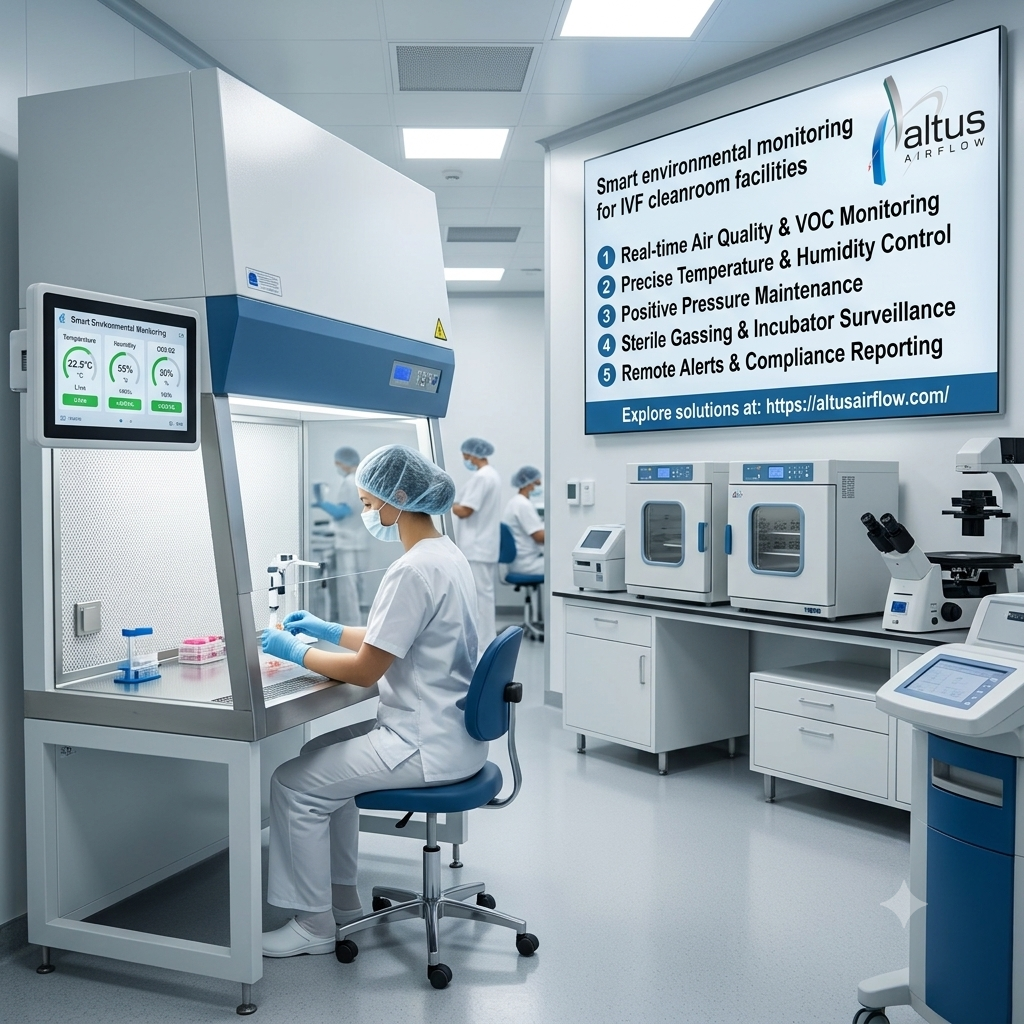
4. Smart Environmental Monitoring Systems
An IVF laboratory requires careful management of environmental conditions because gametes and embryos are sensitive biological materials.
Future facilities may use connected sensors and central monitoring systems to provide better visibility into important operating conditions.
Monitoring may include:
- Temperature
- Relative humidity
- Room pressure differentials
- Airflow performance
- Filter pressure drop
- Equipment temperature
- Incubator conditions
- Selected air-quality indicators
A central monitoring platform can display measurements, maintain historical records, and generate alerts when values move outside defined limits.
For IVF Labs Design, this means planning sensor locations, data connections, alarm systems, accessible control panels, and suitable monitoring arrangements from the beginning.
Monitoring systems should be selected according to the laboratory's risk assessment and quality management programme. Sensors must be calibrated appropriately, alarms must have clear response procedures, and data must be reviewed rather than simply collected.
5. Advanced HVAC and Air Purification Technologies
Heating, ventilation, and air conditioning (HVAC) will remain a fundamental component of future IVF laboratory design.
Modern systems may increasingly combine high-efficiency particulate air (HEPA) filtration, appropriate volatile organic compound (VOC) control, precise environmental regulation, and automated monitoring.
Future developments may include:
- More responsive HVAC controls
- Improved airflow balancing
- Integrated filter-performance monitoring
- Better energy management
- Continuous environmental data logging
- Improved fault detection
- More flexible ventilation control strategies
Air quality management should address both airborne particles and potentially harmful chemical contaminants. VOC sources can include building materials, cleaning products, furnishings, laboratory consumables, and other materials used in or near controlled spaces.
The latest ESHRE recommendations emphasise controlled laboratory environments, air-quality management, and risk-based monitoring.
Designers should coordinate HVAC capacity, filtration, pressure relationships, room zoning, and maintenance access. Exact specifications should follow the intended use, relevant standards, local regulations, and the laboratory's validated operating requirements.
6. Improved VOC Control and Low-Emission Materials
Volatile organic compounds can originate from many sources within a building. In an IVF laboratory, material selection and air-quality management are particularly important because embryos are sensitive to their surrounding environment.
Future laboratory projects may increasingly prioritise:
- Low-emission construction materials
- Suitable sealants and adhesives
- Low-VOC flooring systems
- Carefully selected furniture and finishes
- Appropriate filtration for chemical contaminants
- Controlled storage of chemicals and cleaning products
- Monitoring and investigation of air-quality trends
Material selection should occur before construction rather than after installation. Products should be evaluated for their emissions, durability, cleanability, chemical compatibility, and suitability for the intended environment.
HEPA filtration captures particles but does not, by itself, remove all gaseous chemical contaminants. Where VOC control is required, the design may need suitable gas-phase filtration and a documented strategy for controlling contaminant sources.
7. Digital Laboratory Information Management
Digital management systems are expected to play a growing role in laboratory organisation and traceability.
An IVF laboratory may use digital systems to manage patient identification, specimen tracking, equipment records, quality indicators, and procedural documentation.
Future developments may provide closer integration between:
- Laboratory information systems
- Embryology workstations
- Incubator monitoring
- Cryostorage records
- Equipment maintenance systems
- Digital quality management
- Patient and specimen identification systems
This integration may help reduce manual data entry and make information easier to retrieve. However, digital systems also require access controls, data protection, backups, cybersecurity measures, and documented procedures for system outages.
Laboratory design should include appropriate network coverage, workstation locations, secure equipment connections, and a plan for maintaining essential operations during digital system interruptions.
8. Advanced Cryopreservation and Storage Monitoring
Cryopreservation is an important component of modern fertility treatment. As clinics manage larger numbers of stored reproductive specimens, reliable storage arrangements and monitoring become increasingly important.
Future IVF laboratory projects may incorporate improved storage monitoring, connected alarms, digital inventory systems, and more structured emergency-response planning.
Design considerations include:
- Dedicated cryostorage areas
- Suitable placement of storage equipment
- Reliable monitoring and alarms
- Emergency power for applicable monitoring systems
- Appropriate liquid nitrogen safety arrangements
- Access control and specimen traceability
- Backup procedures for equipment failure
- Emergency response and recovery planning
Storage design should also account for ventilation, oxygen-deficiency risks, safe handling, and the manufacturer's requirements. Liquid nitrogen storage and handling must follow applicable safety rules and should not be treated as an ordinary equipment-placement decision.
9. Microfluidics and Advanced Sample Processing
Microfluidic technologies use small channels and controlled fluid movement to process biological samples. In reproductive medicine, selected microfluidic methods are being developed or used for applications such as sperm preparation.
Future adoption may influence the arrangement of sample-preparation workstations, consumable storage, equipment connections, and workflow separation.
Potential benefits being investigated include more controlled sample handling and reduced reliance on some conventional processing steps. The suitability and performance of a specific system depend on its intended application and supporting evidence.
Laboratories should consider:
- Appropriate sample-preparation areas
- Cleanable work surfaces
- Consumable storage
- Equipment service access
- Workflow separation
- Compatibility with existing laboratory procedures
- Staff training and validation requirements
Microfluidics should be integrated only where the technology fits the clinic's clinical protocols and quality management system.
10. Flexible Modular Laboratory Construction
Modular construction can help clinics organise controlled laboratory environments and plan for future upgrades.
Instead of treating the facility as a fixed arrangement, designers can consider how walls, ceilings, service routes, workstations, and equipment positions may need to change over time.
Future-ready modular design may support:
- Reconfigurable work areas
- Accessible HVAC and utility services
- Additional electrical and data connections
- Planned equipment expansion
- Maintainable wall and ceiling systems
- Easier replacement of selected components
- Reduced disruption during certain upgrades
Flexibility does not mean that every area should be freely reconfigured. Changes to controlled environments can affect airflow, contamination control, workflow, and validation status. Significant modifications may require engineering review, testing, and requalification before the affected area returns to use.
11. Energy-Efficient and Sustainable Laboratory Design
IVF laboratories can be energy-intensive because they depend on environmental control, specialised equipment, refrigeration, and continuous monitoring.
Future projects may focus more strongly on reducing energy consumption without compromising environmental stability or equipment performance.
Possible approaches include:
- Efficient fans and motors
- Well-designed HVAC controls
- Improved building insulation
- Energy-efficient lighting
- Monitoring of energy consumption
- Optimised equipment placement
- Preventive maintenance to preserve efficiency
- Appropriate scheduling of non-critical systems
Energy-saving strategies must be assessed carefully. Reducing ventilation or changing environmental settings without proper evaluation can compromise laboratory requirements. The objective should be efficient operation within the laboratory's approved environmental and safety limits.
12. Improved Ergonomics and Human-Centred Design
Even as automation expands, embryologists remain responsible for many important procedures, decisions, and quality checks. Laboratory design must therefore support staff concentration, precise handling, and comfortable working conditions.
Future facilities may place greater emphasis on:
- Ergonomic workstations
- Adjustable seating and work surfaces
- Appropriate microscope positioning
- Controlled lighting and glare reduction
- Clear pathways
- Logical placement of consumables
- Reduced unnecessary movement
- Dedicated areas for documentation and review
Human-centred design can help reduce avoidable workflow interruptions and improve the practical use of specialised equipment.
The laboratory layout should be developed with embryologists and clinical staff rather than relying exclusively on architectural or engineering assumptions.
13. Stronger Validation, Quality Management, and Regulatory Readiness
As technologies become more complex, validation and quality management will remain essential.
Future IVF laboratories may use more integrated digital records to manage equipment qualification, environmental monitoring, maintenance, training, and performance review.
The design process should account for:
- Equipment installation and performance qualification
- Environmental testing and monitoring
- Calibration and maintenance records
- Patient and specimen traceability
- Standard operating procedures
- Staff training
- Incident and deviation management
- Emergency procedures
- Change control and requalification
ESHRE's 2026 recommendations cover laboratory organisation, quality management, traceability, laboratory safety, and procedures involving reproductive cells and embryos.
In India, facilities must also assess the applicable Assisted Reproductive Technology (Regulation) Act and Rules, along with other relevant requirements. Technology should be introduced only after the clinic has evaluated its suitability, validated its intended use, and established appropriate oversight.
Key Considerations Before Adopting Future IVF Technologies
Not every innovation will be appropriate for every clinic. Before investing, decision-makers should consider:
- Clinical need and supporting evidence
- Compatibility with existing equipment
- Space and utility requirements
- HVAC and air-quality implications
- Installation and lifecycle costs
- Staff training needs
- Maintenance and technical support
- Data security and system reliability
- Validation and regulatory obligations
- Future expansion requirements
A phased implementation strategy may be more practical than attempting to install every emerging technology at once.
Conclusion
The future of IVF Labs Design will likely be shaped by AI-assisted analysis, automation, advanced incubators, smart environmental monitoring, improved VOC control, digital traceability, cryostorage monitoring, and more flexible modular construction. These innovations offer opportunities to improve workflow consistency, monitoring, and operational management, but their value depends on suitable design, evidence-based technology selection, validation, and professional oversight. Planning for future needs during the initial engineering stage can help fertility clinics avoid unnecessary modifications and maintain reliable laboratory operations. For clinics seeking integrated laboratory infrastructure and controlled-environment solutions, Altus Airflow provides engineering and modular cleanroom solutions designed around modern healthcare facility requirements.
Frequently Asked Questions
1. What future technologies will influence IVF Labs Design?
Future IVF Labs Design may incorporate AI-assisted embryo assessment, automated laboratory equipment, time-lapse incubators, digital traceability, connected environmental monitoring, advanced air purification, and improved cryostorage monitoring.
2. How will artificial intelligence influence IVF Labs Design?
AI may influence IVF Labs Design by creating requirements for computer workstations, secure data infrastructure, integrated software, digital imaging systems, and reliable data storage. AI-supported embryo assessment still requires appropriate clinical evaluation and professional oversight.
3. Why is smart environmental monitoring important in IVF Labs Design?
Smart monitoring in IVF Labs Design can help track temperature, humidity, pressure, filter performance, and selected air-quality indicators. Alerts and historical records can help staff identify deviations and investigate problems promptly.
4. Will automation replace embryologists in future IVF Labs Design?
Future IVF Labs Design may accommodate more automated procedures, but automation does not eliminate the need for embryologists. Professional oversight, specimen identification, quality management, exception handling, and clinical judgment remain important.
5. How can modular construction support future IVF Labs Design?
Modular construction can support IVF Labs Design by providing organised service routes, maintainable panels, adaptable work areas, and provisions for future equipment. Modifications must still be assessed for their impact on environmental control and validation.
Read Our Previous Blog------>How does Modular Ophthalmic OT Engineering Company support long-term laboratory maintenance?

 English
 Arabic
 French
 Spanish
 Portuguese
 Deutsch
 Turkish
 Dutch
 Italiano
 Romaian
 Portuguese (Brazil)
 Greek