


Saudi Industrial Customs Duty Exemptions 2026
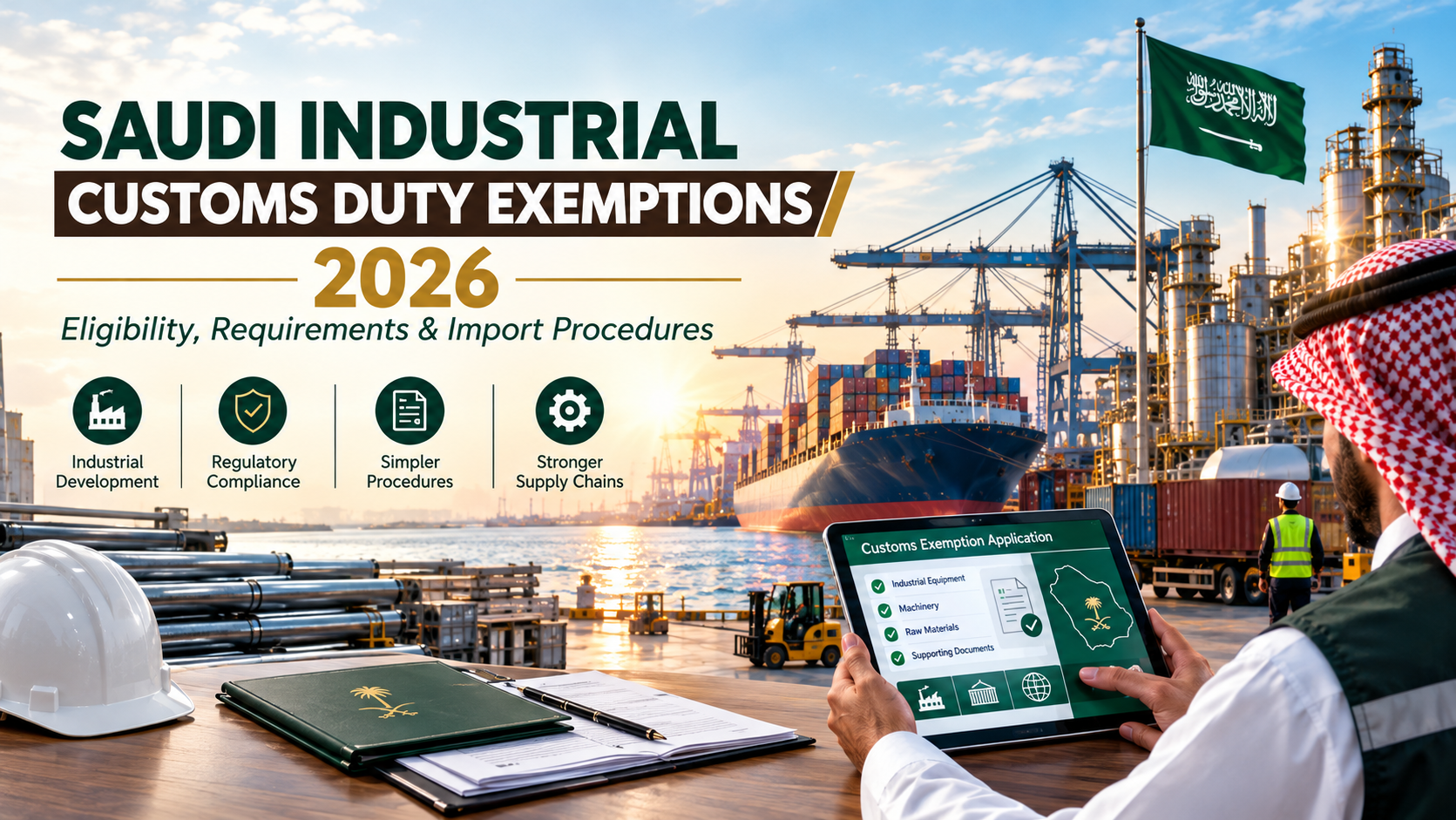
Saudi Arabia offers industrial customs duty exemption programmes designed to support manufacturing, encourage industrial investment and reduce the cost of importing qualifying production inputs. For businesses establishing or operating factories in the Kingdom, understanding saudi industrial customs duty exemptions 2026 can help with import planning, regulatory compliance and production cost management.
These exemptions are not automatically available to every importer or every shipment. Eligibility generally depends on the industrial establishment's licence, the type and quantity of imported goods, the approved exemption decision and the intended use of the items.
This guide explains how industrial customs duty exemptions work in Saudi Arabia, which goods may qualify, how to apply and what businesses should check before importing.
What Are Saudi Industrial Customs Duty Exemptions?
Saudi industrial customs duty exemptions are government incentives that allow eligible industrial establishments to import approved goods without paying the applicable customs duties, subject to the relevant rules and authorisation.
The Ministry of Industry and Mineral Resources administers industrial exemption services, while the Zakat, Tax and Customs Authority (ZATCA) handles customs procedures and related verification.
The programme is intended to support industrial development by reducing certain import costs associated with establishing and operating manufacturing facilities.
According to the Saudi Press Agency, the Ministry expanded the scope of industrial customs exemptions effective April 1, 2024, covering specified industrial inputs and equipment for eligible licensed establishments, subject to applicable conditions. Businesses should verify the current scope and restrictions before relying on an exemption for a 2026 shipment.
Which Goods May Qualify for Industrial Customs Duty Exemptions?
The types of goods covered depend on the applicable exemption programme, approved tariff items and the establishment's authorisation.
1. Industrial machinery and equipment
Machinery used directly in manufacturing may qualify when it falls within the approved exemption scope. Examples could include production-line equipment, industrial processing machinery and specialised manufacturing systems.
The equipment must meet the applicable eligibility conditions. General office equipment or assets unrelated to production should not be assumed to qualify.
2. Spare parts for industrial machinery
Certain spare parts needed to operate or maintain manufacturing equipment may qualify for customs duty relief. Businesses should maintain accurate descriptions, quantities and records demonstrating the intended industrial use.
3. Raw materials
Raw materials used in industrial production can be covered by relevant exemption programmes. However, the rules may differ according to the project's stage.
For example, the government's Customs Exemption for Raw Materials service explains that licensed industrial establishments may seek exemptions for limited quantities used in pilot production during the construction phase. Full licensed quantities are addressed during the production phase, subject to the applicable process.
4. Semi-finished materials and packaging supplies
Certain semi-finished materials and packaging supplies directly required for industrial production may also fall within the relevant exemption scope.
Eligibility should be checked at the tariff-item level. Packaging materials used directly in manufacturing should not automatically be treated the same as general commercial packaging or finished products purchased for resale.
5. Other qualifying industrial inputs
Some exemption decisions may cover additional goods, including specified finished products, depending on the applicable programme and restrictions. Do not assume that every finished product or imported commodity qualifies simply because the importer holds an industrial licence.
For the latest requirements, consult the Ministry's industrial customs exemption services.
Who Is Eligible for Industrial Customs Duty Exemptions in 2026?
Eligibility depends on the relevant service and exemption decision. Common requirements include:
-
A valid industrial licence: The establishment must hold the appropriate licence issued by the competent authority.
-
Matching business information: The commercial registration and industrial licence details should be consistent where required.
-
Eligible goods: The imported items must fall within the scope of the applicable exemption.
-
Approved quantities: Imports must remain within the quantities authorised under the exemption decision.
-
Direct industrial use: Exempted goods must be used for the purpose for which the exemption was granted.
-
Supporting records: The business must retain the required documentation and records for customs verification.
The exact conditions may differ between machinery, spare parts and raw material services. A valid industrial licence alone does not guarantee that every imported item will receive duty exemption.
How to Apply for Saudi Industrial Customs Duty Exemptions
Industrial establishments should prepare their application before arranging shipments that depend on exemption approval.
Step 1: Confirm your industrial licence
Check that your industrial licence is valid and that the establishment details match the information held by the relevant government platforms.
Step 2: Identify the goods to be imported
Prepare a detailed list of the proposed imports, including product descriptions, technical specifications, quantities and applicable customs tariff codes.
Accurate classification is important because the tariff code helps identify the relevant goods and their eligibility under the exemption programme.
Step 3: Gather the supporting documents
Depending on the service, you may need your industrial licence, establishment details, product or machinery descriptions, quantity information and supporting technical or commercial documents.
Check the current application requirements rather than relying on an old checklist.
Step 4: Submit the application through the official platform
Access the relevant Ministry of Industry and Mineral Resources electronic service, enter the requested information and attach the required documents.
For machinery and spare parts, begin with the Customs Exemption for Equipment and Spare Parts service. For raw materials, review the relevant raw materials exemption service.
Step 5: Review the exemption decision
Check the approved items, quantities and any conditions before arranging customs clearance. An application submission should not be treated as proof that the exemption has been granted.
Step 6: Coordinate customs clearance
Ensure that the customs declaration and supporting documents accurately reflect the approved goods. Work with your customs clearance representative to verify the applicable procedure before the shipment arrives.
Important Rules and Restrictions
Exempted goods must be used for their approved purpose
Industrial exemption programmes are intended to support qualifying industrial activity. Businesses should not divert exempted machinery, raw materials or other goods to unrelated commercial purposes.
ZATCA's industrial exemption guidance states that exempted goods must be used for the purpose for which the exemption was granted. Where they cannot be used for that purpose, the establishment must seek the required customs approval and settle applicable duties as instructed.
Approved quantities must be respected
An exemption decision may cover specific quantities. Imports exceeding the authorised amount may be subject to customs duties unless another valid authorisation applies.
Maintain an internal record of approved, imported and remaining quantities to reduce the risk of discrepancies.
Records may be checked
Industrial establishments should preserve exemption decisions, import declarations, invoices, inventory records and evidence of industrial use. These records help demonstrate compliance if the authorities request verification.
Exemption does not remove every import requirement
A customs duty exemption does not automatically waive VAT, other applicable taxes, product conformity requirements, permits or restrictions. Businesses should assess these obligations separately before importing.
How to Check Industrial Exemption Quantities
ZATCA provides an Industrial Exemption Inquiry service that enables users to obtain a report showing deducted and remaining quantities under industrial exemption decisions.
A business can generally access the service through the ZATCA portal, select the appropriate inquiry, enter the requested information, submit the request and download the report.
Regularly reviewing the available quantities can help purchasing teams coordinate imports with approved limits and production requirements.
Common Mistakes to Avoid
Industrial importers should avoid the following errors:
-
Applying without checking the validity of the industrial licence.
-
Assuming every raw material or machine is automatically exempt.
-
Using an incorrect or unverified customs tariff code.
-
Importing quantities beyond the approved limit.
-
Shipping goods before confirming the exemption decision and applicable clearance procedure.
-
Failing to retain evidence of the goods' intended industrial use.
-
Assuming customs duty exemption also means exemption from VAT or product approvals.
A pre-shipment review can help identify these issues before they affect delivery schedules or production costs.
How Radhi Awad Can Help With Industrial Customs Clearance
Industrial shipments often involve detailed documentation, tariff classification, machinery specifications and coordination between suppliers, importers and customs authorities.
Radhi Awad Customs Clearance Co. supports businesses with customs clearance and related logistics services in Saudi Arabia. Professional assistance can help importers organise shipment documents, coordinate clearance procedures and identify issues requiring attention before cargo arrives.
For information about available services, visit the Radhi Awad Customs Clearance Services page.
Businesses seeking industrial customs duty exemptions should confirm their eligibility and approval status with the competent authority before making financial or shipping commitments.
Frequently Asked Questions
1. Who can apply for Saudi industrial customs duty exemptions in 2026?
Eligible industrial establishments with the required industrial licence may apply for exemptions covering qualifying goods. Approval depends on the applicable service, goods, quantities and conditions.
2. Are all imported raw materials exempt from customs duty?
No. Raw materials must meet the applicable eligibility criteria and fall within the relevant approved scope. Businesses should confirm the tariff items and authorised quantities before importing.
3. Can a newly established factory apply for an exemption?
A licensed industrial establishment in the construction phase may qualify for certain services, including limited raw material quantities for pilot production. The relevant service conditions must be checked.
4. Are machinery and spare parts eligible?
Certain machinery, equipment and spare parts used for qualifying industrial purposes may receive customs duty exemption when approved under the relevant programme.
5. Does customs duty exemption cover VAT?
Not automatically. Customs duty relief and VAT are separate matters. Importers should verify their VAT obligations and any other applicable charges.
6. How can a company check its remaining exemption quantity?
ZATCA provides an Industrial Exemption Inquiry service through its official portal. The report can help the establishment monitor quantities deducted and remaining under exemption decisions.
Conclusion
Saudi industrial customs duty exemptions in 2026 can help eligible manufacturers manage the cost of importing machinery, spare parts, raw materials and other approved production inputs. However, the benefit depends on the establishment's licence, the goods' eligibility, the approved quantities and compliance with the applicable conditions.
Businesses should verify current requirements through the Ministry of Industry and Mineral Resources and ZATCA, obtain the necessary approval and prepare their customs documentation before shipment. Careful planning can help reduce avoidable costs and support smoother industrial customs clearance in Saudi Arabia.

 English
 Arabic
 French
 Spanish
 Deutsch
 Turkish
 Dutch
 Italiano
 Russian
 Romaian
 Portuguese (Brazil)
 Greek