


How can fertility clinics plan for future expansion through IVF Labs Design?
INTRODUCTION
Fertility clinics planning for long-term growth must consider more than their immediate laboratory requirements. IVF Labs Design should incorporate flexible layouts, scalable utilities, controlled environmental conditions, efficient embryology workflows, and provisions for additional equipment to support future clinical demand. A well-planned laboratory allows fertility clinics to expand their services without unnecessary structural changes or major interruptions to ongoing operations. By considering future treatment volumes, staffing requirements, cryopreservation capacity, emerging reproductive technologies, and regulatory obligations during the initial planning stage, clinics can establish a laboratory environment that supports sustainable growth while maintaining quality, safety, and operational efficiency.
Why Should Fertility Clinics Plan for Future Expansion?
Fertility clinics may experience increasing patient numbers, introduce new assisted reproductive technologies, or expand their diagnostic and embryology services. A laboratory designed only for current requirements can quickly become overcrowded, creating workflow bottlenecks and making equipment installation more difficult.
Future-ready planning helps clinics:
-
Accommodate increasing treatment cycles.
-
Provide space for additional laboratory equipment.
-
Improve staff movement and workflow efficiency.
-
Increase cryopreservation and storage capacity.
-
Support environmental monitoring and quality management.
-
Reduce disruption during future modifications.
-
Control long-term infrastructure and renovation costs.
Expansion planning should begin before construction. Clinic owners, embryologists, architects, HVAC engineers, biomedical specialists, and laboratory designers should jointly establish current requirements and realistic growth scenarios.
1. Assess Current and Future Clinical Demand
The first step is estimating how the clinic's services may develop over the next five to ten years. This does not mean predicting growth with certainty; it means identifying plausible scenarios and ensuring the laboratory can accommodate them.
Clinics should evaluate:
-
Current and projected IVF treatment cycles.
-
Expected demand for ICSI and other procedures.
-
Number of embryologists and laboratory technicians.
-
Expected embryo culture and cryopreservation workload.
-
Potential introduction of additional laboratory services.
-
Required storage, administrative, and support areas.
For example, a clinic expecting increased treatment volumes may need additional incubator capacity, more workstations, expanded cryostorage facilities, or improved specimen-handling arrangements.
Capacity estimates should be based on operational data and clinical plans rather than simply allocating extra floor space. Every proposed addition should have a defined purpose, utility requirement, and workflow benefit.
2. Design a Flexible Laboratory Layout
A flexible layout allows clinics to modify selected areas as operational needs change. Instead of filling every available space with equipment during the initial phase, designers can identify areas that may support future workstations, storage, or additional technical equipment.
Important planning considerations include:
-
Modular furniture and adaptable workbenches.
-
Accessible service routes and maintenance clearances.
-
Space for future equipment installation.
-
Expandable electrical and data infrastructure.
-
Accessible HVAC components and service panels.
-
Clearly defined laboratory and support areas.
Flexibility must not compromise controlled environmental conditions. Any future layout change should preserve the laboratory's validated workflow, environmental controls, and applicable safety requirements.
ISO 14644-4:2022 describes the process of planning, designing, constructing, and starting up cleanrooms, including new, refurbished, and modified installations. Its lifecycle approach is useful when planning future laboratory alterations and verification activities. Source: ISO 14644-4:2022.
3. Plan for Efficient Embryology Workflow
Embryology workflow is central to a successful IVF laboratory. Reproductive cells and embryos must be handled in controlled conditions, and laboratory arrangements should minimize unnecessary movement and handling time.
The 2026 European Society of Human Reproduction and Embryology (ESHRE) recommendations emphasize appropriate laboratory functionality, efficient workflow, and suitable environmental conditions for reproductive cells and tissues. Source: ESHRE recommendations on good practice in the IVF laboratory.
A future-ready laboratory should consider the relationship between:
-
Oocyte retrieval and specimen reception.
-
Sperm preparation.
-
Insemination and ICSI workstations.
-
Embryo culture and monitoring.
-
Embryo transfer preparation.
-
Cryopreservation and storage.
-
Cleaning, sterilization, and support activities.
The precise layout depends on the clinic's procedures and operating model. Administrative work, staff changing, and activities involving hazardous chemicals should be appropriately separated from sensitive embryology operations.
Planning for additional staff and equipment should not increase unnecessary specimen movement or create conflicting workflows. A proposed expansion should be reviewed by experienced embryology personnel before implementation.
4. Build Scalability Into HVAC and Air Quality Systems
Environmental control is one of the most important considerations when planning an expandable IVF laboratory. Additional equipment, increased occupancy, and modified room layouts can change heat loads, airflow distribution, pressure relationships, and air-quality requirements.
The HVAC strategy should account for:
-
Current and projected heat loads.
-
Required temperature and humidity control.
-
Suitable air distribution.
-
HEPA filtration where specified.
-
Volatile organic compound (VOC) control.
-
Fresh-air requirements and pressure relationships.
-
Environmental monitoring and alarm systems.
-
Access for maintenance and future upgrades.
ESHRE's 2026 recommendations highlight HEPA filtration and VOC control, appropriate ventilation, positive pressure as a recommended approach, and regular air-quality monitoring. They also emphasize risk-based assessment of air cleanliness and the importance of suitable construction materials. These recommendations should be considered alongside applicable local regulations and the laboratory's engineering specification.
Clinics should avoid assuming that an existing HVAC system will automatically support future expansion. Engineers should calculate the additional load and verify system performance before new equipment or work areas are commissioned.
5. Reserve Space for Future Laboratory Equipment
Laboratory technology evolves, and fertility clinics may introduce equipment that requires additional space, power, cooling, data connections, or specialized environmental controls.
Potential future equipment may include:
-
Additional embryo culture incubators.
-
ICSI workstations and micromanipulation systems.
-
Time-lapse embryo monitoring systems.
-
Advanced microscopy equipment.
-
Electronic witnessing and traceability systems.
-
Cryopreservation equipment and monitoring devices.
-
Laboratory information management solutions.
During initial planning, designers should prepare an equipment schedule identifying dimensions, utility requirements, maintenance clearances, and operating conditions.
Reserved space should not be treated as unrestricted empty space. Its future use must be assessed for airflow, electrical capacity, ergonomics, equipment compatibility, and cleanroom requirements.
6. Expand Cryopreservation and Storage Capacity
Cryopreservation planning is essential for clinics that anticipate increasing embryo, oocyte, or sperm storage volumes. Storage capacity must be evaluated together with access, monitoring, safety, and emergency arrangements.
Expansion planning should address:
-
Projected storage demand.
-
Safe positioning and access to storage equipment.
-
Temperature or level monitoring appropriate to the system.
-
External alarms for critical equipment.
-
Backup power for relevant monitoring and support systems.
-
Emergency response procedures.
-
Inventory management and traceability.
Cryostorage facilities should be planned with the required safety precautions and suitable proximity to relevant laboratory operations. Storage arrangements should not obstruct the main embryology workflow.
Additional tanks or storage equipment may introduce new space, ventilation, and safety requirements. Clinics should assess these requirements before adding capacity rather than waiting until the existing storage area becomes overcrowded.
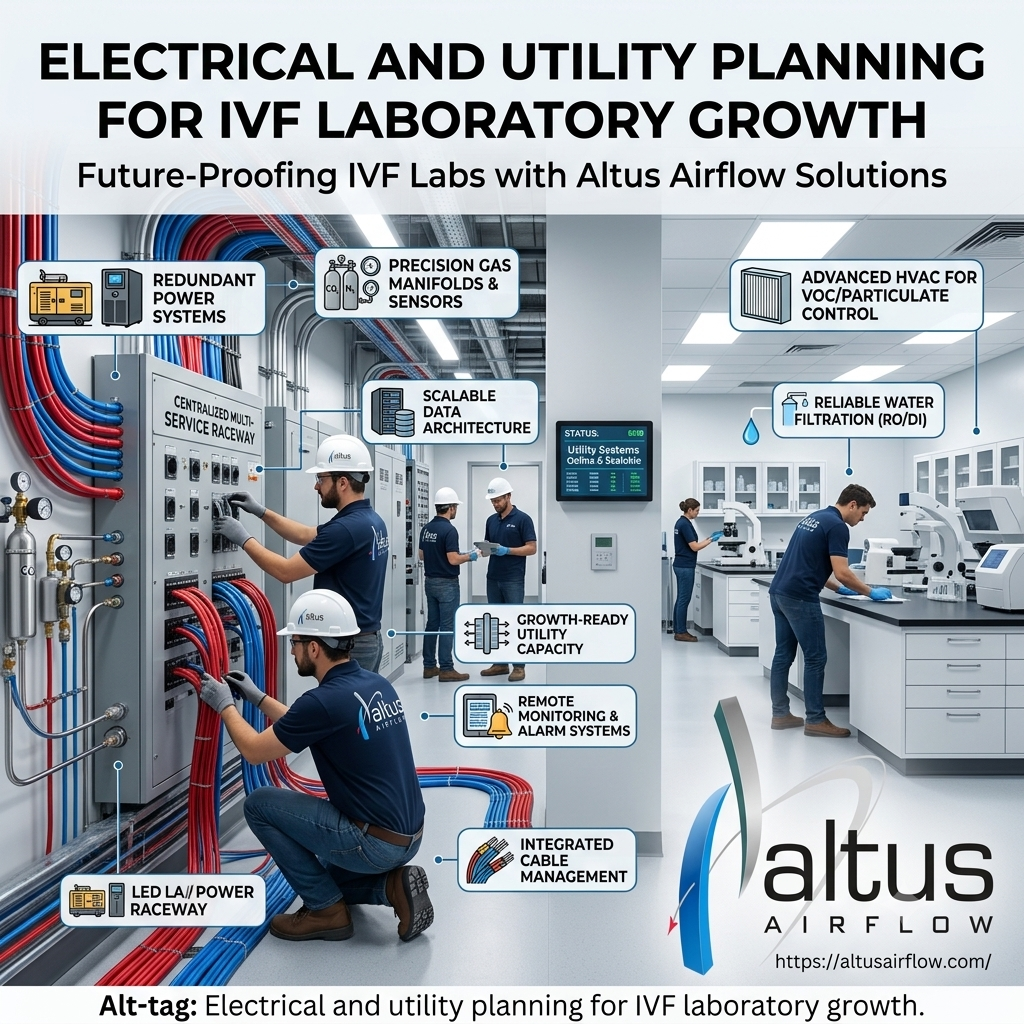
7. Design Scalable Electrical, Data, and Utility Infrastructure
Infrastructure upgrades can be expensive when walls, ceilings, or floors must be reopened. Planning additional capacity during the initial design can make future modifications more manageable.
Clinics should consider:
-
Electrical distribution capacity.
-
Backup power for critical equipment.
-
Dedicated circuits where required.
-
Network connections and data points.
-
Environmental monitoring connections.
-
Medical-grade or high-purity gases where applicable.
-
Utility isolation and maintenance access.
-
Space for future control panels and equipment.
The design should include documented utility loads and spare capacity where technically and economically justified. Spare capacity must be calculated by qualified engineers; adding extra circuits or connections without a load assessment may create safety risks.
Critical incubators, cryostorage systems, and monitoring equipment should have suitable alarm and emergency arrangements based on the laboratory's risk assessment.
8. Select Expansion-Friendly Materials and Finishes
Materials used in IVF laboratories must support cleaning, durability, and environmental quality. Some construction products, adhesives, paints, sealants, furniture, and flooring may release VOCs that are undesirable in sensitive embryology environments.
A future-ready design should consider:
-
Low-emission construction materials.
-
Cleanable and durable work surfaces.
-
Appropriate flooring and wall finishes.
-
Sealed joints and hygienic detailing.
-
Materials compatible with approved cleaning agents.
-
Modular components that can be repaired or replaced.
-
Sufficient time for off-gassing after construction or renovation.
ESHRE's 2026 recommendations specifically highlight minimizing VOC release from laboratory construction, flooring, furniture, and related materials. They also recommend allowing suitable off-gassing time following construction or renovation.
Material selection should therefore be reviewed before procurement. When expansion involves new finishes or construction products, the clinic should assess their compatibility with the existing laboratory and determine whether environmental testing or a recommissioning process is needed.
9. Plan for Compliance, Validation, and Future Modifications
An expandable laboratory must remain compliant with applicable requirements as it grows. Adding a workstation or moving an incubator may affect environmental conditions, utilities, workflow, and documented operating procedures.
A planned modification should include:
-
A documented change request.
-
Assessment of clinical and engineering risks.
-
Review of applicable regulations and standards.
-
Evaluation of HVAC, electrical, and utility capacity.
-
An approved installation and work plan.
-
Testing and verification after the modification.
-
Updated drawings and equipment records.
-
Staff training and revised procedures where necessary.
The ESHRE recommendations provide guidance on laboratory organization, equipment, environmental quality, cryopreservation, and quality management. In India, clinics must also assess applicable requirements under the Assisted Reproductive Technology (Regulation) Act, 2021, and its associated rules.
Validation requirements should be determined according to the scope of the modification and the relevant standards. Not every change requires the same level of testing, but no modification should be assumed harmless without an appropriate assessment.
10. Use Phased Expansion to Control Costs
Phased expansion allows a clinic to invest in additional capacity when demand justifies it. The initial design can establish essential infrastructure while reserving defined areas and services for later stages.
A phased plan may involve:
-
Phase 1: Establish the core IVF laboratory, essential equipment, and required support facilities.
-
Phase 2: Add workstations, equipment, or storage as treatment volumes increase.
-
Phase 3: Expand laboratory functions or supporting facilities after a documented capacity review.
Each phase should have a clear budget, timeline, clinical justification, and commissioning plan. Costs should include more than construction and equipment purchase; they may also involve validation, temporary service interruptions, staff training, and ongoing maintenance.
Phased expansion should not result in an undersized HVAC system, insufficient utility capacity, or inadequate environmental control during the initial stage. Essential infrastructure must be suitable for the approved operating requirements from the beginning.
11. Establish Long-Term Maintenance and Capacity Reviews
Expansion planning should continue after the laboratory becomes operational. Regular reviews help determine whether the existing layout and infrastructure remain appropriate as clinical demand changes.
Clinics should monitor:
-
Equipment utilization and maintenance history.
-
Incubator and cryostorage capacity.
-
Environmental monitoring trends.
-
HVAC and filtration performance.
-
Staff workload and workspace availability.
-
Utility demand and backup arrangements.
-
Changes in clinical procedures and regulatory requirements.
A periodic capacity review can identify problems before they affect daily operations. It can also help clinics prioritize investments and avoid unnecessary expansion.
Conclusion
Planning for future growth through IVF Labs Design requires a coordinated approach to layout flexibility, embryology workflow, HVAC capacity, air quality, equipment placement, cryopreservation, utilities, materials, and regulatory compliance. Fertility clinics should assess future demand early, reserve capacity where justified, and ensure that every modification is appropriately reviewed, tested, and documented. This approach can reduce avoidable renovation costs while protecting the environmental conditions essential to laboratory operations. For fertility clinics seeking scalable laboratory planning, cleanroom engineering, and integrated infrastructure solutions, Altus Airflow can support the development of adaptable facilities designed around current requirements and future operational needs.
Frequently Asked Questions
1. Why is future expansion important in IVF Labs Design?
Future expansion planning helps clinics accommodate increasing treatment volumes, additional equipment, and changing clinical services without unnecessary disruption. IVF Labs Design should incorporate scalable utilities, flexible layouts, and efficient embryology workflows from the beginning.
2. How can IVF Labs Design accommodate additional laboratory equipment?
Designers can assess future equipment dimensions, electrical loads, data connections, maintenance clearances, and environmental requirements. IVF Labs Design should reserve suitable space and infrastructure without compromising cleanliness or workflow.
3. How does HVAC planning support expansion in an IVF laboratory?
HVAC planning accounts for changes in heat loads, airflow, temperature, humidity, filtration, and pressure relationships. IVF Labs Design should include engineering assessments to determine whether existing ventilation systems can support future equipment and occupancy.
4. Can an IVF laboratory be expanded in phases?
Yes. A phased approach can allow clinics to add equipment, workstations, and storage capacity as demand grows. IVF Labs Design should provide a practical expansion roadmap while ensuring that essential environmental controls and utilities meet current requirements.
5. What role does cryopreservation play in future IVF Labs Design?
Cryopreservation planning addresses future storage volumes, safe equipment placement, monitoring, alarms, emergency procedures, and traceability. IVF Labs Design should provide suitable storage arrangements without obstructing the main embryology workflow.
Read Our Previous Blog------>What maintenance requirements should be considered in Modular Ophthalmic OT Engineering Company?

 English
 French
 Spanish
 Portuguese
 Deutsch
 Turkish
 Dutch
Dutch
 Italiano
 Russian
 Romaian
 Portuguese (Brazil)
 Greek
Greek